
Adapting a sales document for multiple markets
The problem, in practice
Adapting a sales document for a new market is not limited to translating it: units, cultural references and sometimes even the structure of the document also need to be adapted. Redoing this work by hand for every market consumes a disproportionate amount of time relative to the task's actual added value.
81% of companies investing in AI choose a custom-built solution or a purpose-built development rather than a standard tool (Bpifrance, Baromètre IA 2026). A generic translation tool only covers the linguistic part of the problem, not the cultural and regulatory adaptation specific to each market.
What the tool does, in practice
A custom-built tool designed for this case takes your source sales document and adapts it according to the parameters specific to each market: language, units, and the cultural references identified as relevant to your business.
The number of markets covered at once, the depth of adaptation required and the level of human review before release, market by market, are not decided in advance: these points are precisely the purpose of the audit.
How we work
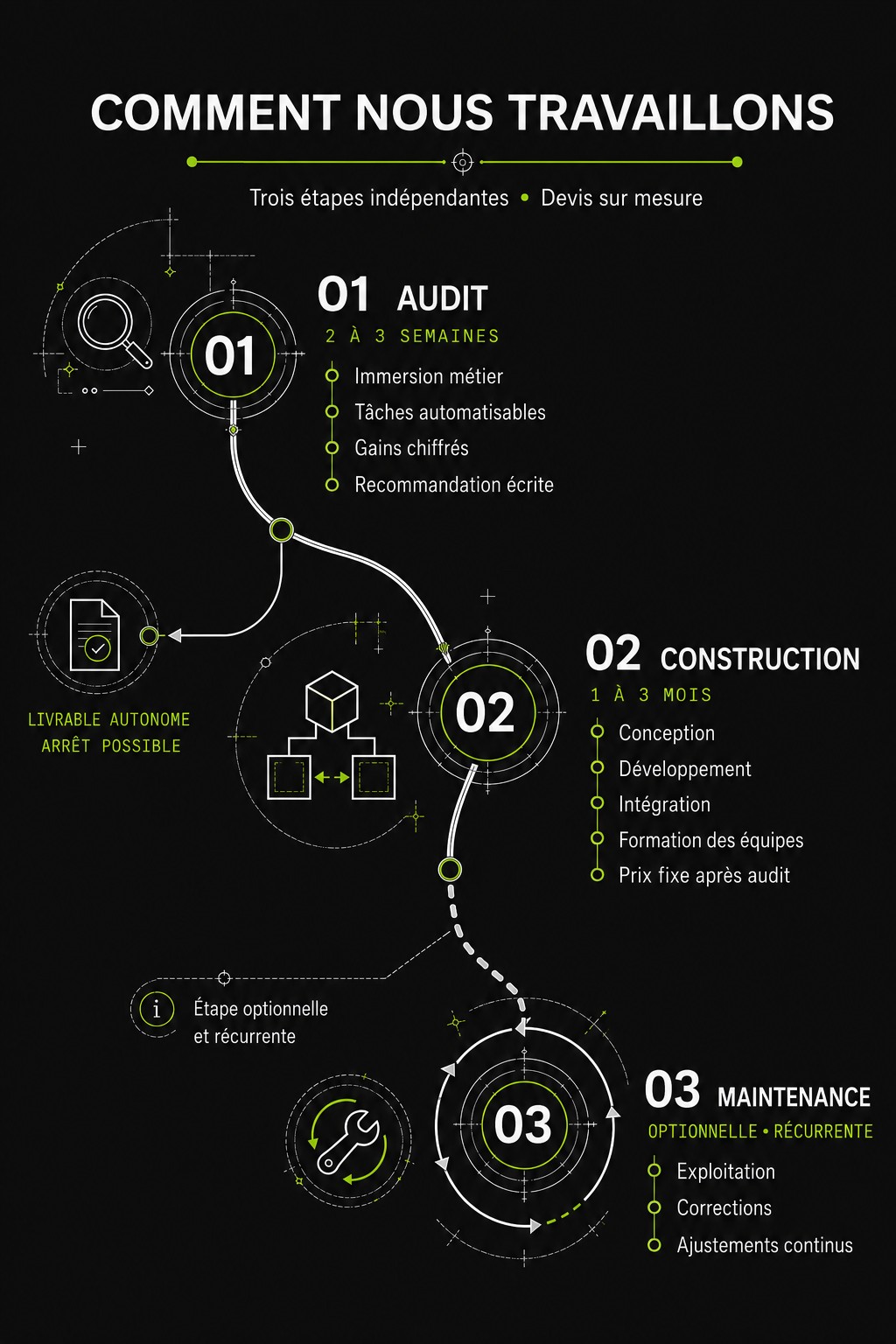
Three steps, each independent: you can stop after the audit.
Immersion in your source document and target markets, costing of the expected gain, written recommendation.
Design, development, integration with your existing tools, then training for your teams.
We adjust the tool as your source document evolves or as you open new markets.
Frequently asked questions
Does the tool translate, or does it do more than translation?
The goal goes beyond translation: also adapting units, cultural references and elements specific to each market. The exact scope of this adaptation for your document is defined during the audit.
How many markets can be covered at once?
The number of markets to cover is one of the parameters examined during the audit: it directly influences the costing of the build, rather than being an assumption fixed before we have seen your document and your target markets.
Who validates the adaptations before release?
The level of human validation before release, market by market, is one of the choices arbitrated during the audit, based on your risk tolerance and the stakes specific to each market.
How long does setup take?
The general timeline for Sundatalab custom-built projects is a 2 to 3 week audit, followed by a 1 to 3 month build. The exact duration depends on the number of markets and the complexity of the source document.
What happens if the source document changes or new markets are added?
That's the role of optional maintenance: we adjust the tool as your source document evolves or as you open new markets, without starting a new project each time.
See other Studio use cases
Product sheets for a catalog of thousands of items
Generating and maintaining consistent product sheets for a catalog too large to write by hand.
Read the use case →Technical assistant for your sales team
Answering, in seconds, the technical questions your sales team asks repeatedly, drawing on your internal documentation.
Read the use case →Automated client reports
Automatically turning raw operational data into readable reports, ready to send to your clients.
Read the use case →Start with an audit
We look at your document and your target markets, we estimate what automation would bring, and we tell you whether to build it, or not.
